Sunday, June 26, 2011
Gear Review: SPOT Connect
A specific piece of equipment has been catching my eye for at least the last three issues of Backpacker Magazine (funny/pathetic how their advertising gets me every time...). I have wanted a SPOT locator beacon for a couple of years now, but due to my current financial situation as a student, it is one of those many pieces of technology that will need to wait until after I'm done with school. When I saw the advertisement for the SPOT Connect I thought that I had found a better alternative that would give me an even greater justification to purchase such a devise following my graduation, but I'll let you decide which of these two devices is superior.
SPOT Satellite GPS Messenger
For a basic overview of what the SPOT beacon does, check out this post I wrote several months ago. The SPOT beacon is a small hand-held device which allows you to "check in" anywhere in the world (as long as the beacon has a signal from the satellite - caves and many slot-canyons don't). You pay for the device (about $80-150 according to the search I just did on-line), and then pay for the yearly service plan (basic is $100, and goes up from there). You have the ability to check in with loved ones through the SPOT tracker website, send "custom" messages via e-mail (have to set this up with a computer before your trip), inform your contacts at home that you need non-emergency assistance, and then you can also use the SOS button in case of a real emergency.
The Cost: Unit + yearly subscription = two charges. Depending on how many features you want to have access to, the subscription cost goes up. Only one-way communication if this is the only form of communication you have. Even if you are where you would have a cell signal, you won't be able to talk to anyone or text anyone unless you have your cell phone with you.
The Benefit: A peace of mind for your loved ones while you are in no-mans land, and a peace of mind for yourself if you were to be in a sticky situation.
SPOT Connect
The biggest difference between the Connect and the Messenger above is an ability to customize your e-mails that you are sending home (also send a customized message along with your SOS so the authorities know what they are dealing with), as well as an ability to send text messages and to update your Twitter/Facebook status. Due to the fact that you are using a secondary device, you have more options and abilities. At this point you can use an iPhone, iPod Touch (HUGE surprise to me when I found out about this), or an Android with a 2.0 or newer platform. You have the ability to use every feature that the Messenger has, but much more. Right now the Connect device is roughly $150, and, just like the Messenger, you have a yearly subscription fee ($99) which will cost more depending on how many texts/e-mails you would like to send.
The video below is very informative, and quite amusing. I don't know who the guys are doing the interview, but the SPOT rep knows what he is talking about (for the most part). Be sure to pay attention to what he says about sending a customized SOS message. I'm not sure if he is being serious or ironic, but it's entertaining nonetheless.
Costs: Instead of only taking one device to use as an SOS when the poop hits the fan, you have to have the Connect AND your iPod/iPhone. If one of the batteries dies on either of these devices, there is no point in having the second one - unless, of course, you have a cell phone signal and can just call out. In addition to having to care for two devices, you are also taking more weight (a minimal 4.5 oz for the Connect) and more space being taken up in your pack. The pictures on-line are deceiving in my opinion. At first glance I thought it was a flat device, but it's not. It is still smaller than a smart phone, but is probably two or three times thicker.
Benefits: All the same features as the Messenger, only much better. If you are able to send a customized message along with your SOS ping, the authorities will know if they are dealing with a broken leg, someone who has fallen in a tough to reach location, or you are being eaten by a bear (which is what the rep said in the video...hahaha, "help me, the bear is almost to my organs as he has already exposed my rips and is working his way through my gluteus maximus"). Having two devices means you have twice the opportunity to get help and send status updates. If you have a cell phone signal on the trail then you can call whoever you want, if you don't then you can just use the Connect features. Almost like having a security blanket on the trail:)
Here is the promo video from SPOT. Although a little cheesy, it's still pretty informative. Does a good job of showing that this device is not just for your backcountry adventures.
The Bottom Line: Although the main purpose for me purchasing either the Connect or the Messenger is for my backcountry activities, they would both be very useful for road trips and really any possible situation. I feel that the Connect offers much more than the Messenger, and will hopefully be an owner of the Connect one day. The up-front cost of the device is a little steep (as with the Messenger), but the yearly subscription ends up costing less than most data plans for smart phones when divided between twelve months.
Here are a few reviews to read if you are interested: One, Two, and Three.
Sunday, May 22, 2011
Outdoors Essentials??? Multi-Function Watches
For couple of years now I have lusted after an image found in every issue of Backpacker magazine. Every time I would open my latest issue, I knew that I would eventually come across the same advertisement for the same watch that fascinated my adventerous side, and this is what I would see...
The latest Casio Pathfinder is solar powered (which will last 5 months after being fully charged), includes an altimeter, barometer, thermometer, digital compass, and every other typical digital watch feature (alarms, timers, ect) only done better. For an MSRP of $450, this is a watch that any outdoorsman would lust after. Here is the point of this post though: Should a multifunction watch be included on the "outdoors essentials" list?
My logic in even wanting a watch such as the Pathfinder is the pure convenience of having so much useful information strapped to my wrist when in the backcountry. An altimeter (when correctly and frequently calibrated correctly) would give more accurate directions/locations when using a topo map, a barometer can be useful when trying to predict the weather (if you know how to use it), the digital compass would be convenient when wanting a quick reference for the direction you are traveling (although not the most accurate when compared to a mirrored compass like the one I use), and the solar power charge means that you are set when it comes to power (no having to worry about your battery losing its life in the middle of a trip [you should switch out your battery more frequently than required for this exact reason]).
In addition to the expensive features are the typical alarms and stopwatch - both would be very useful when on the trail. I still remember camping with a bunch of neighborhood friends a couple of years ago. They all had to leave right after breakfast the next morning, so I knew that I would need to get up at a decent hour in order to see them before they all took off. I woke up to the sun hitting the corner of my tent, and had an eery feeling that I was all alone although I went to bed with five tents surrounding me the night before. It was only 8 in the morning, but everyone was already gone! I felt like the crazy drunk uncle who everyone wants to avoid the morning after a night in the woods. I thought that I was getting up early enough, but only had the sun to wake me up. For this reason (and the fact that I typically want to get an early start on the trail when backpacking) an alarm on my watch would be perfect. No extra weight, very small, and conveniently located on your wrist whenever you need it.
The thermometer would also be very useful when backpacking/camping. I can't recall how many times I have woken up to a freezing face in the middle of the night, wondering if it was really below freezing, or if I was just a wimp. Having this feature on my watch would allow me to see how cold it really is at night so that I can see if my sleeping bag's temperature rating is more liberal than it should be (although I'll admit that there are small thermometers that are dirt cheap and very light/small which would be just as effective).
The downside? Price. How could a starving grad-student possibly afford a wrist watch that costs more than $300? Although there are other Pathfinder watches that are much cheaper to be found ($200 on REI), it's still an expensive watch. The solution? I was walking through REI when I saw a watch for $60. It was also a Casio brand, also had an altimeter/barometer/thermometer, and was pretty good looking. I don't know whether I will really use all the extra/expensive features on the Pathfinder, so why not buy a cheaper watch to see if the Pathfinder is really worth the money or not? Here is the watch that I found and later bought.
The bottom line: I wouldn't put multi-function watches on the "outdoors essentials" list. It is a fun and convenient extra gadget to wear around, but not necessary by any means. I will say, however, that any type of watch DOES belong on the list. Remember 127 Hours? Each and every one of those hours were counted by Aron Ralston while stuck in the slot canyon. Knowing what time it is may very well be the one thing that makes the difference between keeping one's sanity, and losing one's mind. Aron rationed out his water in order to make it last as long as possible. There was no way he could have kept track of time if he wouldn't have had a watch on him (high canyon walls and only a small window of direct sunlight would have made it impossible to tell the time). Some in hostage situations have also said that knowing what time it was made a huge difference (knowing the time of day gives one a small sense of being in control).
I know that I focused on the Pathfinder by Casio, but Suunto is also a very good watch, and may be more used by professional mountaineers than the Pathfinder is. As a side note, both the Suunto and the Pathfinder are BIG watches. If you prefer the more conservative, low-profile watch, these multi-watches may not be fore you.
Sunday, April 24, 2011
A Few Amazing Videos
Yes, I'm taking the easy route by sharing a few videos instead of writing a real post. My finals are coming to an end, and I should, in theory, be able to get back to my regular "weekly" posting within the next couple of weeks.
I saw this first video a couple of weeks ago. It took place all the way back in 2008, so I'm obviously not a rock climber. Seeing this video, in addition to the other videos in this post, makes me want to lose the 20 lbs I put on after getting married so that I can take on this physically demanding sport (although my love for backpacking will always be #1).
This second video features Ueli Steck and the same climber from the first video. Ueli (again, only recently discovered this video) is AMAZING. I had no idea that speed climbers even existed! What this guy does impresses me more than I can express. Hundreds of thousands, if not millions, of people world-wide train for marathons each year, thousands also train for long bike rides, triathlons, swim meets, and many other sports which require absolute dedication, but what Ueli does is, by far, the most dangerous sport by far. Running up a mountain without ropes??? Crazy...
This last video shows Ueli breaking his own speed climbing record on the north face of Eiger. Don't know what Eiger is? Check it out here. Why the north face? The north face of mountains in the northern hemisphere is usually known as being the most difficult to summit (which is also probably why "The North Face" clothing line is called what it is). Watch this last video and be amazed.
If those videos aren't enough to inspire you, I have no idea what would:)
I saw this first video a couple of weeks ago. It took place all the way back in 2008, so I'm obviously not a rock climber. Seeing this video, in addition to the other videos in this post, makes me want to lose the 20 lbs I put on after getting married so that I can take on this physically demanding sport (although my love for backpacking will always be #1).
This second video features Ueli Steck and the same climber from the first video. Ueli (again, only recently discovered this video) is AMAZING. I had no idea that speed climbers even existed! What this guy does impresses me more than I can express. Hundreds of thousands, if not millions, of people world-wide train for marathons each year, thousands also train for long bike rides, triathlons, swim meets, and many other sports which require absolute dedication, but what Ueli does is, by far, the most dangerous sport by far. Running up a mountain without ropes??? Crazy...
This last video shows Ueli breaking his own speed climbing record on the north face of Eiger. Don't know what Eiger is? Check it out here. Why the north face? The north face of mountains in the northern hemisphere is usually known as being the most difficult to summit (which is also probably why "The North Face" clothing line is called what it is). Watch this last video and be amazed.
If those videos aren't enough to inspire you, I have no idea what would:)
Thursday, April 7, 2011
Book Review: Between a Rock and a Hard Place
A few years ago I flipped through this book too see if it was something that I would enjoy reading. After I realized that it was filled with Aron Ralston's "adventures," I lost interest and felt that he probably used his accident in Southern Utah as an excuse to shot (what he considered were) his amazing accomplishments, and to talk himself up. I'll admit that it was probably my own pride that I was using as a filter, and didn't really want to hear about a kid my age achieving more within one year of his life (by way of outdoors accomplishments) than I accumulated as a whole up to that point in my life.
As soon as I was done watching 127 Hours for the first time, I decided that it would be a good idea to give the book a chance. About two weeks after this decision, I found my thoughts constantly going back to different parts of the movie, wanting to watch it more and more, and being driven to the bookstore. Being in graduate school and on a very tight budget, making extra purchases are very rare for me, but I felt that this book would be a good investment for my bookshelf.
From the start of this book I decided to ask myself whether Aron was really at fault for the predicament he found himself in - caught between a slot canyon wall and chock stone he dislodge while hiking the Blue John Canyon within The Canyonlands National Park. Although the many different adventures found within the book annoyed me several years ago, and kept me from taking the book seriously, I found that these all gave me a great deal of insight into his personality, his mental preparedness, and his ability to accurately (or better, inaccurately) weigh the consequences of his actions.
There is a common theme I found throughout the book: Aron likes to be alone. He took (and continues to take) pride in his ability to summit Colorado's 14,000+ feet-high peaks by himself. When he isn't alone, he ends up making poor choices, such as: the time he was with his sister at Havasupai Falls and fell on a cactus; or the time he was with a couple other guys and almost drowned in the Colorado River; or when he pressured his friends to drop down into a steep bowl of deep powder when skiing, only to trigger a massive avalanche which almost claimed their lives. Even when he was at The Canyonlands, he chose to follow through with his plan to hike Blue John Canyon, despite the fact that two girls he thought were attractive tried to convince him to go with them on their hike. It is my own personal opinion that he felt that it would be more impressive to the girls he met, if he were to continue his solo journey. He didn't say it, but it was his pride in doing things by himself which ultimately lead to his demise.
I can dissect the entire book, but feel that doing so would take away from the enjoyable parts which left me wanting to stay up late to read every evening.
I didn't see how Aron could possibly grab my attention with his writing to the point where I wait in anticipation for him to finally cut his arm off (hope this isn't a spoiler for any those reading this). He did such an excellent job of writing with great detail, that you honestly felt like you were with him each night as he struggles to fight through the hypothermic conditions - all while unable to give his legs enough rest to finally fall asleep. As he goes through his routine of wrapping his legs with his climbing rope, as he puts his head in his rope bag, and as he tries with all of his might to get a few minutes of sleep before his next designated time to take a sip of water - all of these moments you feel as though you right there with Aron, each step of the way.
I got to the point where I asked myself if the next page would be when he would have his "epiphany" or not. Although it is easy for me to say that I would have cut my arm off a lot sooner than he did, I understood through his writing that I, too, would probably need to get to that extreme point of desperation where I realized that I was left with no other option then to take that final plunge.
Hopefully none of this takes away from the experience to be had when reading the book for yourself. Yes, he was a hot-headed kid who took unnecessary risks, but at the end you come to realize that the previous risks he took gave him the courage to take that final risk which ultimately saved his life. Although I found myself asking why Aron made so many poor choices up to that point in his life, by the end of his story I understood that those poor experiences may very well have prepared him for that final pinnacle moment where he found himself stuck, "Between a Rock and a Hard Place."
(A short clip from Aron's original tapes while in the slot canyon)
*As an interesting side-note, Aron's book is no longer titled "Between a Rock and a Hard Place." The new edition which came out after the movie, and which I ended up purchasing (only because this was all that could be found on the shelves), is titled "127 Hours Between a Rock and a Hard Place."
Sunday, March 13, 2011
Website Review: Peakery.com
I came across Peakery.com a couple of days ago, and have spent plenty of time on it already. Apparently it is a newer site, but has a huge database of information. Want to research a peak for a future hike? It's there. Want to "claim" a peak after having conquered it? Upload a photo, and add it to your list of completed hikes. Want to see a list of "baggers" who have climbed peaks in your area? A long directory is there for your use. All of these features are made possible by a user friendly website that is very cut and dry, and FREE! I have found websites like this before, but they required you to pay a yearly subscription in order to get "full" access.
After "claiming" the very few peaks I have "bagged," I realized that my list is quite small and pathetic. Mind you, this site is only for peaks, not for long trails or other achievements. Due to the fact that it is focused on peaks alone, it makes it possible to get all the information you could possibly want about a peak. In addition, after you upload a photo of a peak, it is available for everyone else to see. To top it off, your homepage shows the last time you bagged a peak (a friendly reminder to motivate you to get out more), and shows a photo of the last peak you bagged on your home page (this will either be a photo you took, or a stock photo).
![]() |
| As you can see, I have very few peaks that I have bagged. I can't decide which is more embarrassing, the lack of Peaks, or how many days it's been since the last one I summited... |
Sunday, February 27, 2011
Trip Report: Tetons - Paintbrush Divide & Cascade Canyon Loop
| Sunset from our campsite situated in front of the cathedral group |
Over a year ago I went on the best hike of my life to-date. What, you may ask, actually defines a hike as being "the best"? Pristine scenery, prime weather, great company, and the list goes on and on. In saying this, I must admit that anything I try to explain in this post will fall short of doing justice - hopefully the photos will help though.
Two years before planning this trip, I slowly began saving up for my backpacking equipment. About a year before, I started donating plasma once or twice a week for the sole purpose of purchasing everything I would need for such backpacking trips. Once I saw this suggested hike in Backpacker Magazine, I wanted it to be the first hike to test out all of my equipment, and to finally start my backpacking adventures.
| Holly Lake - where we stopped for lunch, and had a failed fly-fishing attempt |
| Second photo taken during the trip - LOVE when the scenery makes every photo look as though it has been edited |
The hike on the first day was brutal. This was the first time that I had ever carried 40+ pounds of equipment on my back, let alone the first time I did so while hiking up the side of a mountain. Although I fared well the first half of the day, taking a break for lunch (and a poor attempt at fly fishing) was just enough for my body to decide that it didn't like the heat, didn't like the extra load, and didn't like the gain in elevation. I didn't realize it at the time, but looking back on it, I can see that my labored breathing, mild headache, and extreme fatigue = heat exhaustion. This came at the worst possible time (as if there is ever a good time for heat exhaustion), as we had just begun the final push to the divide and crossed through snow and climbed up a slippery field of shale rock.
| Looking into the valley where we camped |
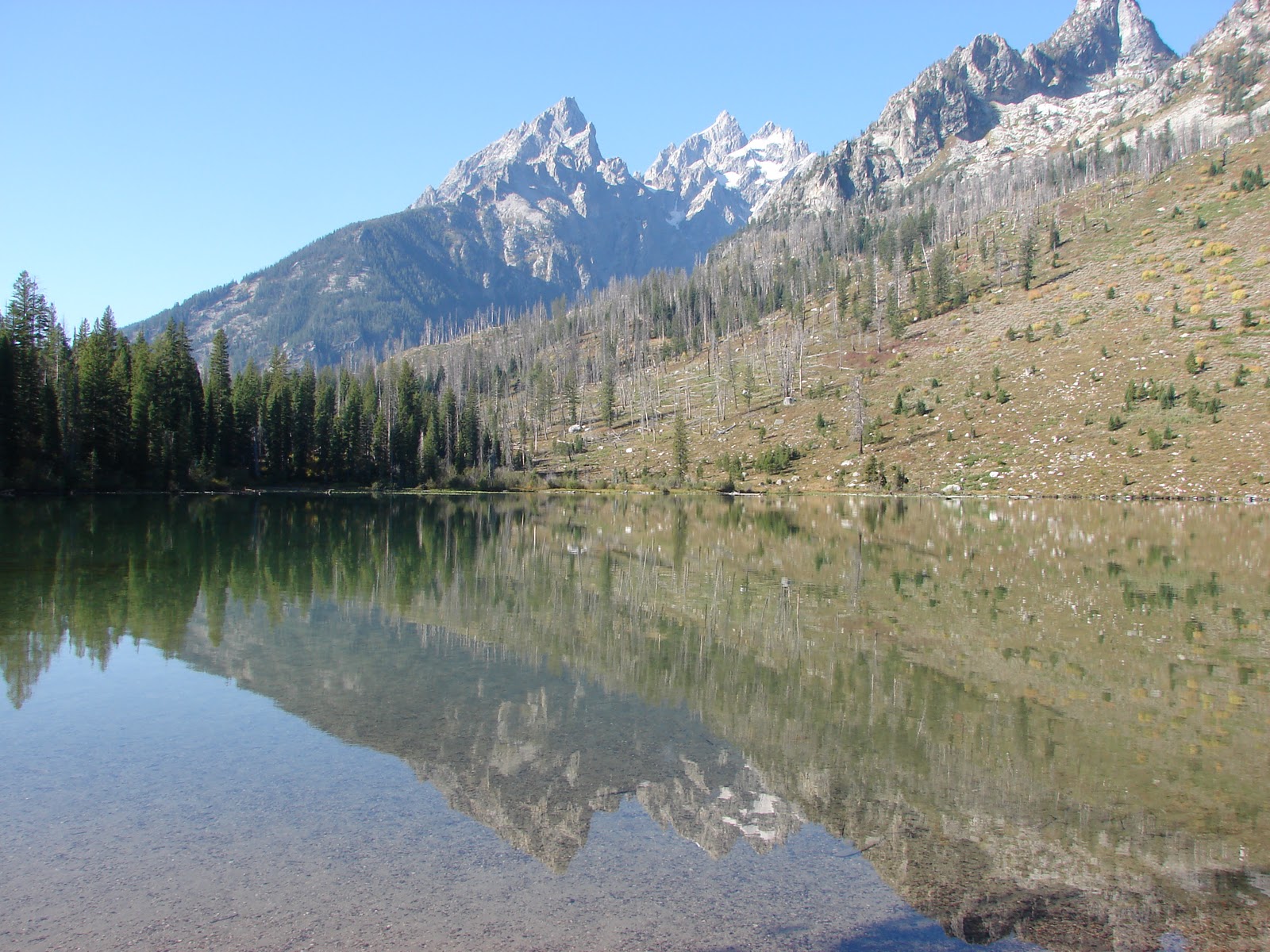
The best part of this trip was, by far, the fact that our campsite had a perfect view of the cathedral group that makes up the breathtaking skyline so many are familiar with. We were all alone at our campsite, which only added that much more to this amazing experience. Arriving just before a magnificent sunset almost felt as though the Tetons were welcoming us after a long, strenuous climb.
| Saying farewell to the Tetons |
![]() |
| Up Paintbrush, camped at Solitude Lake, and then down Cascade |
One of my favorite parts of this trip occurred when driving back home to Provo. I called one of my best friends to tell him about the amazing time I had, and told him that I would love to come do it again when he would be able to join me. Assuming that he would see that being my willingness to drive such a long distance again for this same exact trip would be an indicator of how great the trip really was, he instead said, "it sounds like a long way to drive just for a hike...". This took me back for a second, but I laughed it off, and promptly sent a text to Geoff, relaying the message. I realized after this conversation that backpacking is not for your regular day-hiker, and that it really does take a higher level of commitment to plan such a trip, carry it out, and actually enjoy it. I was reminded once again how lucky I am to have a friend who shares my desire and passion to be in the outdoors.
Best trip EVER!!!!
Monday, February 14, 2011
Out of the Wild: The Alaska Experiment
My brother in-law told me about some show that it was "right up (my) alley" a couple of weeks ago, so I figured I would take his word for it and check it out. I'm glad I did! I ended up finishing the complete (and only) season of Out of the Wild: The Alaska Experiment within a week.
Out of the Wild starts with 9 random individuals from various walks of life - all intent on surviving the Alaskan wilderness for 30 days or more, and on nothing but what they can find along the way for food. The purpose of the "experiment" is to see how many can make it through without pinging their SPOT locator beacon. If someone gives up, than he or she simply hits the button, and a helicopter picks him or her up. After that, it's to civilization, easy meals, and the warmth and comfort of being home.
During the very first episode you learn that the group went through basic survival training before starting the trip, but they don't specify what that training really consisted of. You do find out that they learned how to make Yukon packs, but it's apparent that they didn't learn about how to be selective when choosing what to carry and what to leave behind. Before starting the first leg of their trip, they are given a bunch of supplies to go through for their various needs while on the trail. They foolishly decide to bring everything "just in case" (interesting that this folly was never mentioned by the narrator or any of the participants) they end up needing it. I mean they even brought a thirty pound cast-iron dutch oven!!! May not be the smartest bunch of people, but still entertaining nonetheless.
The group is given maps to find each destination to hike towards throughout their trip, and each destination has a different form of shelter for them to stay in. Sometimes it is a decent cabin with additional supplies and a stove, and other times it is little more than a little rock wall they tie their tarps to in order to keep the wind and rain out. Sometimes their spirits are lifted as they see that they have a decent bed to sleep in, and other times it is too much for one or two of them to handle, and they end up pinging their beacons.
There were several intriguing parts of this show, but I'll only name a few for the sake of not having to write a complete novel:
- During the very first episode the group foolishly decides to take a "short-cut" by hiking over a high hill-top instead of following the trail found on the map, and which suggests walking through the valley. 50+ pounds in each Yukon pack + several out-of-shape individuals = a nice start to the series.
- It was interesting to me to see the lack of know-how that the members of this group had. I thought that it would be interesting to throw a seasoned backpacker in the group to help them survive, but realized that the producers probably thought this would make things too simple.
- The main focus on the show is really how difficult it is for the group to find enough to eat, but it does get annoying when the narrator repeats dozens of times how many calories they have been able to digest by eating squirrels and birds, yet they each need thousands of calories more than what they have found. Personally, I think the show would have been more entertaining if the group had started on their trek at least a month earlier than they did instead of waiting until the very end of Fall - at which point everything starts to die, and wildlife seems to vanish.
- It seemed that the cameras were quite selective with what they did and did not show. Not once did you see what the group was forced to go through each time they had to use the bathroom - they never even MENTIONED having to go to the bathroom during the 30+ days they are in the wilderness! Going to the bathroom would have been an especially big deal for the girls as two in particular didn't seem to be very comfortable in the outdoors. The cameras also failed to show how difficult it was to collect water and to purify it. I seriously wondered if the producers of the show provided the water in order to keep anyone from dying...
- Whatever survival training they received seemed to be very limited. They were able to spot berries from a mile away, yet passed over all sorts of insects, worms, and several other plants they could have eaten. In reality, they were so focused on meat for protein that they didn't think about the lack of vitamins they had. Survival 101 - meat is not enough when trying to survive for a long length of time. Without eating the proper vitamins and minerals, your energy will never be replenished,
For the most part, I really enjoyed this show, but I can see why there has only been one season. Without enough success (such as finally killing big game in order to eat well), the audience loses interest. It's interesting to see the group suffer after repeated failed attempts to catch fish, snare small game, and find large game, but this sad story can only loop so many times before the viewer becomes frustrated. I was impressed that the individuals of the group got along as well as they did, but it would have been nice to see someone who was really educated to take control and be a hero in this impossible situation. By the end of the series you get the sense that the group is only trying to hike out of the situation, and have forgotten about trying to survive - not to mention enjoying themselves. I was surprised how many times they chose to collect wood or play house instead of searching for food. Instead, they give one or two the responsibility to find food while the rest do other random things.
One of the most profound moments that stuck out to me in this series actually occurred during the second episode. The one guy who has any experience in the outdoors (a fly-fishing guide) becomes annoyed when the group was willing to stop repeatedly when one member continuously stops to catch his breath. I asked myself if I would have done the same thing. If one individual is threatening the whole group's safety by stopping continually, all the while the daylight continues to diminish and the stopping point is still miles away, would I tell the group to leave him behind? Would I pull him to the side and tell him to ping his beacon for the sake of the rest of the group? Or would I, myself, ping my locator beacon and leave the group to fend for itself? Ironically enough, both the experienced outdoorsman AND the slow-poke ping their beacons and get taken out on a helicopter.
I don't think I would recommend this show to anyone who doesn't find enjoyment in watching a group of average-Joes struggling to navigate and survive in the wilderness. I personally enjoyed everything about the show, but can understand why it didn't make it past the first season.
Subscribe to:
Posts (Atom)